



Ars Apomedica
From the Collections of the Sadberk Hanım Museum and Ömer Koç
The exhibition takes journeys made to Ottoman lands between the close of the fifteenth century and the first quarter of the twentieth, and organises them around the motives that set travellers in motion. At its centre are travel accounts, texts that treat travel less as movement from one place to another than as a deliberate practice of selecting and recording. Alongside them are paintings that show the world of the period and objects relating to Ottoman geography. The exhibition was prepared for the centenary of the Koç Group.
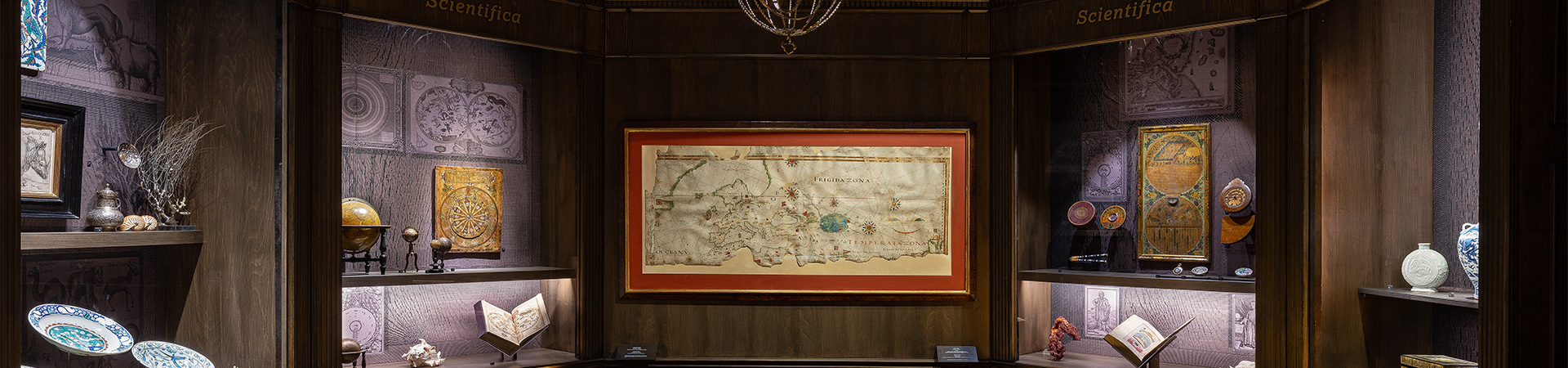
The era the exhibition takes as its starting point, and the traces that era left behind, led us elsewhere as we worked: to the cabinets of curiosity. The impulse that produced a travel account and the impulse that gathered objects brought from distant lands into a single cabinet share a common root, and that cabinet is the first nucleus of the museum as we know it. We built the sequence of the exhibition on this thought.
The ground floor belongs to the seventeenth century. The setting is theatrical; objects assembled out of quite different motives sit stacked within wooden furniture. The floor above carries the atmosphere of the mid-twentieth-century museum. The cabinet from below has become a vitrine here, and the vitrines stand in file, one after another, answering to the collecting, researching and classifying duties of the museum of that period. The top floor comes closer to present-day museum practice. Traits inherited from that first cabinet remain legible in the vitrines, but what now comes first is the visitor’s experience. Artistic installations that deepen that experience are part of the display.
The second layer of the design concerns the logic of these cabinets. The method of analysis and synthesis brought by the seventeenth-century scientific revolution continues within the cabinet of curiosity: the like parts of a whole are separated into distinct cabinets and distinct shelves, and knowledge of the whole is pursued through close study of those units. The method does not remain in science. It passes into the cultural field. This is the approach that built the civilisation we live in.
The point at which that same method falters can also be read from this exhibition. On the upper floors, unnamed but present, are the traces of Orientalism. Seeking to know the East through its parts, the West failed to grasp it whole, and to this was added an inclination to diminish the East in order to elevate itself. The objects gathered on these travels, and those produced from what was seen on them, carry the record of both tendencies at once.
The impasse is felt today not only in the field of knowledge but across every area of life. In science, meanwhile, a shift of paradigm comparable in force to that of the seventeenth century is quietly under way: the approach of connectivity, which we came to know through Prof. Dr. Türker Kılıç, proceeds by examining things in their wholeness. As with the earlier revolution, we may expect this one to make its way into social life slowly. The exhibition does not show this new approach. What it shows is what came before it, and this is precisely why it connects to the present.
The world, if not in the same form, is living through a kind of medieval darkness beneath a mask of enlightenment. The exhibition reminds us of this, and there must be some meaning in its opening now. What changes across the three floors is not only the typology of the vitrine but the way of knowing behind it, and therefore the way of showing, of looking, and of seeing.
- Exhibition Design
- Production
Photography: Barış Aras & Elif Çakırlar


